


When tackling the challenges of growing competition, many managers of medium-sized Lithuanian companies notice that a functional product alone is no longer enough to ensure a smooth conversion journey. When every user interaction can determine success or a lost customer, carefully evaluating and improving the quality of the user experience (UX) becomes the most important IT priority. The methods discussed in this guide will help you clearly structure and effectively implement UI/UX changes aimed at greater satisfaction and growth in business results.
Content Management
- Step 1: Evaluate the current user interface and experience
- Step 2: Identify user needs and goals
- Step 3: Prepare an improved design concept
- Step 4: Implement the UI/UX changes in the project
- Step 5: Test and evaluate user reactions
- Step 6: Optimise based on the feedback collected
Quick summary
| Key point | Explanation |
|---|---|
| 1. Analyse the user experience | Evaluate the current interface and identify points for improvement using surveys and behaviour analysis. |
| 2. Identify user needs | Conduct UX research to understand users' motives and journeys, including in-depth interviews and observation. |
| 3. Create an improved design concept | Sketch and prototype, continuously evaluating user feedback and refining the design. |
| 4. Implement the design changes | Collaborate smoothly between the design and development teams and ensure clear communication. |
| 5. Optimise based on feedback | Collect user feedback and analyse it systematically to improve the product's functionality. |
Step 1: Evaluate the current user interface and experience
To create an outstanding design, you first need to carefully analyse the current user interface and user experience. This evaluation will help determine the product's strengths and weaknesses and identify specific points for improvement.
Start with a thorough user experience analysisof the current interface. For this purpose we recommend applying several main evaluation methods:
- User survey: Collect direct insights about their experience
- Behaviour analysis: Observe real patterns of how users use the product
- Usage metrics: Evaluate the efficiency and performance of interactions
- Focus group research: Get in-depth information about user needs
A quality UI/UX evaluation is the foundation for successful design improvement.
When carrying out the evaluation, pay attention to the main principles of digital product design, such as accessibility, clarity and intuitive navigation. Every design decision must be based on concrete data and insights into user behaviour.
Professional tip: Document every stage of the evaluation and keep detailed notes, which will later become a valuable resource for further design decisions.
Here is a comparison of the main UI/UX evaluation methods and the value they return to the business:
| Method | Value provided | Use cases |
|---|---|---|
| User survey | Deep subjective insights | For quickly gathering opinions |
| Behaviour analysis | An objective data basis | For long-term experience monitoring |
| Usage metrics | Precise performance measurement | For identifying efficiency gaps |
| Focus group research | Deep analysis of motives | For clarifying functional needs |
Step 2: Identify user needs and goals
Successful UI/UX design starts with a deep understanding of what your users really want. UX research is essential to reveal the real needs and motives of users, which will help create intuitive and effective digital solutions.
To identify user needs, we recommend applying these methods:
- In-depth interviews: Direct communication with users
- Behaviour observation: Analysis of real user interactions
- Surveys: Collecting quantitative data
- User journey map: Detailed tracking of the product usage process
Every method of revealing user needs must be systematically documented and analysed.
UX research makes it possible not only to understand user behaviour but also to reveal their deeper needs and expectations. It is important not only to collect data but also to interpret it critically, looking for in-depth insights that can become the basis for design improvement.

Professional tip: Every week, review the collected user needs data and look for recurring patterns that may reveal opportunities not yet seen.
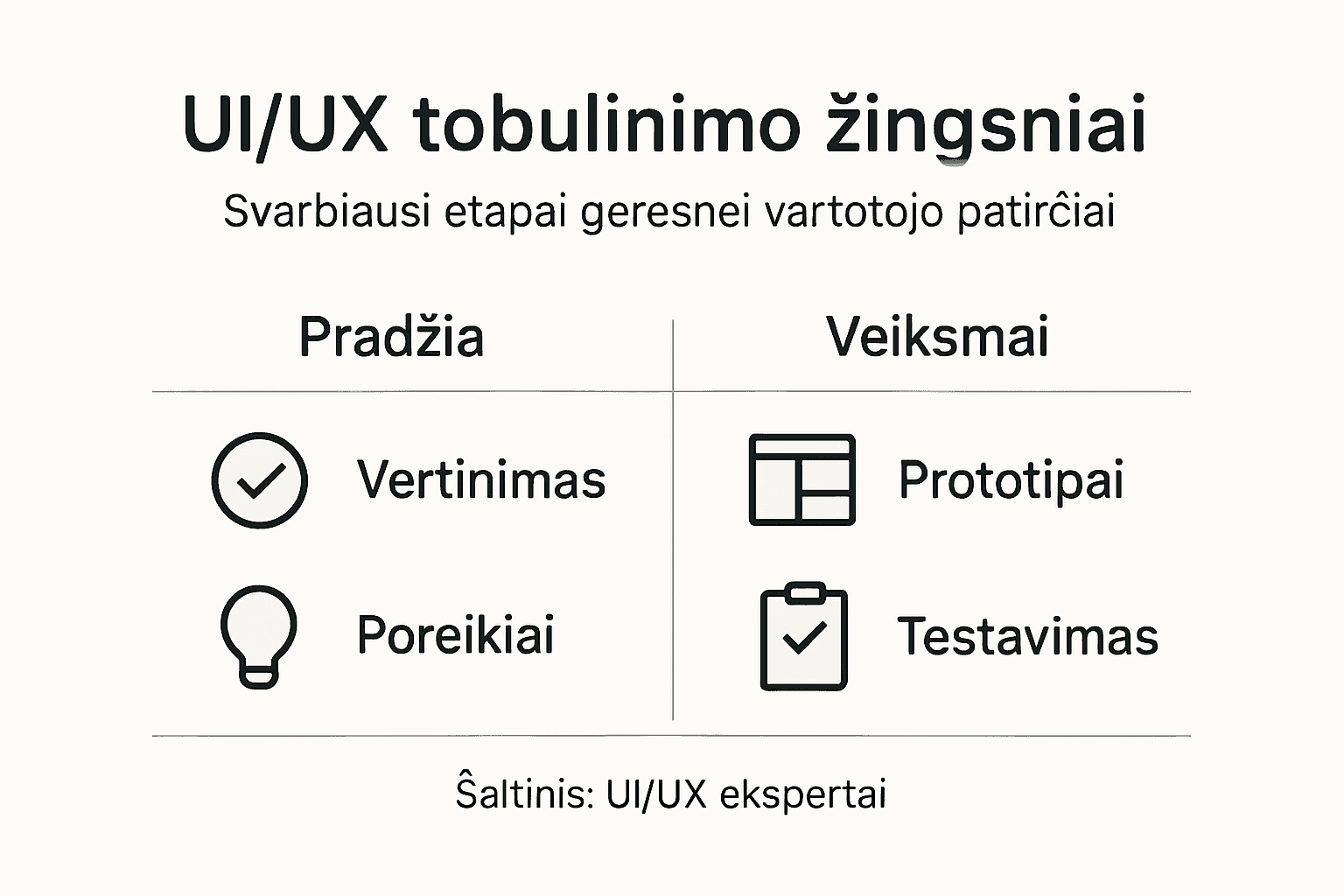
Step 3: Prepare an improved design concept
An improved design concept is the key to a successful user interface that not only looks attractive but also functionally addresses user needs. User-centred design principles are fundamental when creating an effective design that will truly meet user expectations.
To prepare an improved design concept, take these main steps:
- Sketching: Create initial design sketches that reflect user needs
- Prototyping: Create an interactive model of the product
- Evaluation: Evaluate the prototype with the target user group
- Refinement: Adjust the design based on the feedback received
Good design is a process of continuous improvement and experimentation.
Every stage of creating the design concept must be carefully planned and implemented. It is important to constantly test and review your decisions to ensure maximum functionality and user satisfaction.
Professional tip: At every stage of design improvement, involve at least one external expert who can give an objective opinion.
This table highlights the most common UI/UX design improvement challenges and effective ways to solve them:
| Challenge | Solution | Expected result |
|---|---|---|
| An unclear user journey | Create a journey map | Better user orientation |
| Low engagement | Include interactive elements | Increased user activity |
| Insufficient testing | Regular UX testing cycles | Fewer unexpected errors |
| Hard-to-understand navigation | Simplify the menu structure | Faster finding of features |
Step 4: Implement the UI/UX changes in the project
Implementing UI/UX changes is a critical stage that requires consistent planning and close collaboration between teams. Successful design implementation depends on smooth communication between the design and development teams.
The main steps for successfully implementing changes:
- Communication: Clearly convey the design vision and expectations
- Component library: Create and use a unified design system
- Iterative improvement: Constantly test and adjust the solutions
- Technical implementation: Integrate the design solutions into the development environment
Successful implementation of UI/UX changes requires continuous collaboration and flexibility.
Using modern frameworks can significantly ease the technical implementation of design changes. Regular interim meetings will help ensure that all team members understand and implement the planned solutions.
Professional tip: Document every stage of the design changes and keep previous versions so that you can return to earlier solutions if needed.
Step 5: Test and evaluate user reactions
Evaluating user reactions is an essential stage that lets you understand whether the created design really meets their expectations and needs. Hybrid interaction research methodologies help analyse user behaviour and responsiveness more deeply.
Recommended evaluation methods:
- Usability tests: Observe real user behaviour with the product
- A/B testing: Compare different design versions
- Focus group discussions: Get detailed qualitative feedback
- Behaviour analysis: Evaluate user interaction patterns
A precise understanding of user reactions is the key to successful product design.
Evaluative UX research helps determine the product's usability and effectiveness before the final launch. Continuous collection of feedback makes it possible to constantly refine the design and improve the user experience.
Professional tip: Document every review and piece of feedback received and look for recurring patterns that may reveal fundamental design flaws.
Step 6: Optimise based on the feedback collected
Optimisation based on user feedback is a continuous process that makes it possible to consistently improve the product's design and functionality. Feedback analysis methods help systematically extract and interpret user insights.
The main optimisation steps:
- Data collection: Summarise all the feedback received
- Statistical analysis: Identify recurring problems
- Prioritisation: Focus on the most critical points for improvement
- Experimental implementation: Try out the proposed modifications
Every piece of feedback is an opportunity to improve the product's design.
Methodologies for integrating user feedback provide more than just technical solutions. Continuous design improvement requires an open attitude and flexibility.
Professional tip: Create a clear system for collecting, analysing and promptly responding to every piece of feedback received.
Improve your business's UI/UX design with professional help
The challenges raised in the article – how to thoroughly evaluate the user experience and implement effective design solutions – are important for every business seeking to strengthen its digital image. If you face challenges in identifying user needs, creating a design concept or continuous optimisation, it is important to have a reliable partner who will help you effectively implement all UI/UX improvements.
Our team consists of experienced specialists who specialise precisely in creating and applying UI/UX solutions for business. Visit simplex.lt and find out how our website development services and innovative design solutions will help you implement every step from user analysis to successful implementation. Don't miss the chance to improve the appeal and functionality of your digital platform today with the help of our experts.
Discover how consistent and professional UI/UX improvements can change your business's digital success by choosing simplex.lt as your reliable technology partner.
Frequently asked questions
How to start evaluating the current user interface and experience?
To start evaluating the current user interface, conduct user surveys and behaviour analysis. Collect feedback directly from users and observe how they interact with the product in order to identify opportunities for improvement.
What are the main methods for identifying user needs?
The main methods for identifying user needs include in-depth interviews, behaviour observation and user journey maps. Use these methods to gain a thorough understanding of user expectations and requirements.
How to effectively prepare an improved design concept?
To prepare an improved design concept, first create sketches and then prototypes so that you can test them with target users. Evaluate the feedback received and refine the design accordingly so that it is effective and attractive.
What steps to take when implementing UI/UX changes in a project?
When implementing UI/UX changes, first ensure clear communication between the design and development teams. Create a component library and constantly test and adjust the design solutions based on the feedback received.
How to evaluate user reactions after a design update?
To evaluate user reactions, conduct usability tests, A/B testing and organise focus group discussions. Collect and analyse the information received to understand how well the updated design meets user expectations.
What actions to take when optimising the design based on user feedback?
For optimisation, collect all the feedback received and carry out a statistical analysis to identify recurring problems. Prioritise the points for improvement and experiment with the proposed modifications to achieve better results.
